


There's a moment every scaling company hits. It's not dramatic. Nobody rings a bell. But if you've been there, you know it.
You've crossed a threshold - usually somewhere around 100 to 200 people - and things that used to work just... don't anymore. The culture that felt tight and intentional starts feeling diffuse. Communication that used to be organic now requires coordination. And the people systems that served you at 40 people are quietly failing you at 150.
I've seen this pattern so many times that I can almost predict the sequence.
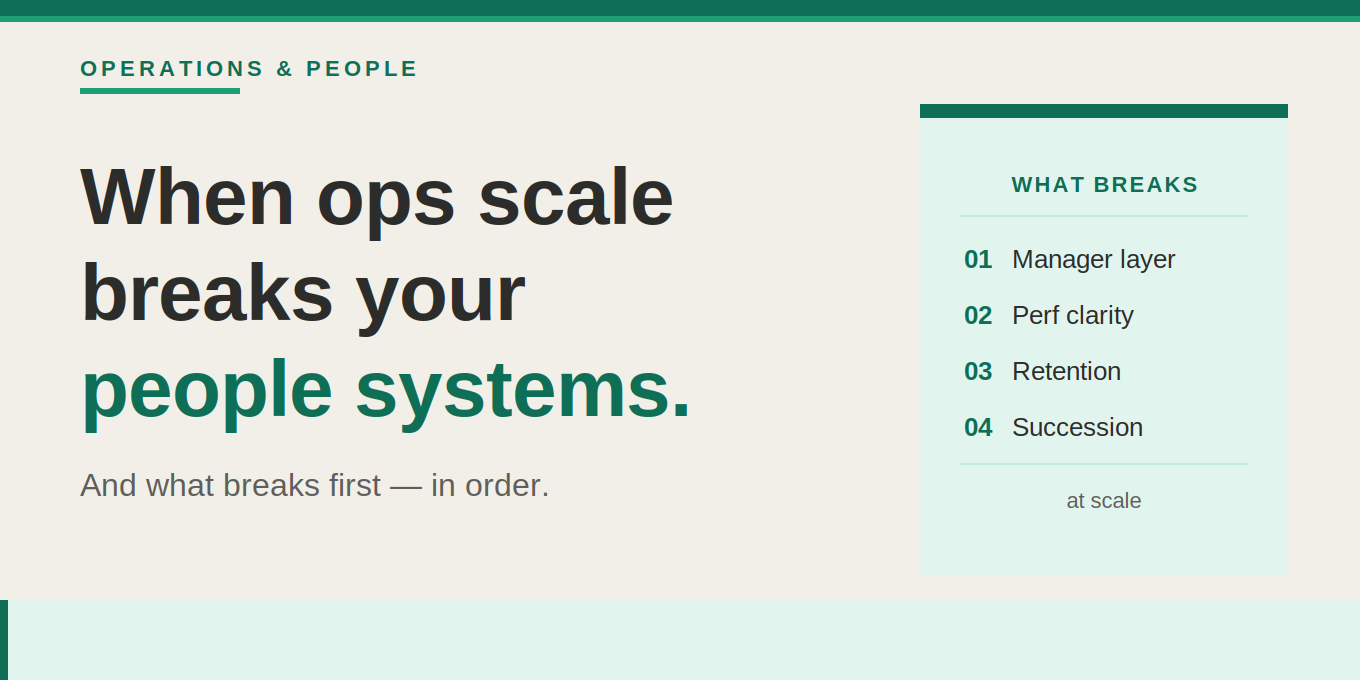
Here's what breaks, and in what order.
First to break: the manager layer
Before you hit scale, most companies are running on founder gravity. The founder is the culture. The founder is the accountability system. The founder is the one who knows every person, can course-correct in real time, and holds the institutional memory.
Then you grow. The founder can't be everywhere. So you promote your best operators into management roles.
And this is where the first crack appears.
Being an excellent individual contributor and being an excellent manager are two completely different skill sets. One is about your own output. The other is about creating conditions for other people to produce great output. One is execution. The other is multiplying execution through humans.
Most promoted managers have never been taught the second part. They lead the way they were led - which may or may not have been effective. They make decisions alone that should be made with their teams. They give feedback inconsistently. They protect their people from hard truths because it feels kinder in the moment.
The result: their teams slow down. Decisions stack up. Your best people on those teams start feeling micromanaged or, paradoxically, directionless - sometimes both at once.
Second to break: performance clarity
Here's a question I ask every executive team I work with: if I walked up to anyone on your ops team right now and asked them what excellent performance looks like in their role, would they give me a clear answer?
Most of the time, the honest answer is no.
At small scale, performance clarity lives in the founder's head and gets transmitted through proximity. You can see who's doing good work. You can give feedback in real time, informally, because you're sitting near each other.
At scale, that system breaks completely. The founder isn't in the room anymore. Managers are too busy executing to coach. Performance reviews, if they happen at all, are inconsistent; sometimes fair, sometimes political, almost never tied to any agreed-upon standard.
What this creates is a workplace where your top performers have no idea they're your top performers, and so they don't feel the stickiness that recognition and trajectory create. And your under-performers have no idea they're underperforming, and so the problem compounds quietly until it explodes publicly.
Clear performance standards, consistently communicated and consistently reviewed, are not a nice-to-have at scale. They're structural infrastructure. Without them, everything wobbles.
Third to break: retention - specifically of the people you can least afford to lose
Here's the part that stings.
When people systems break down, the people who leave first are almost never the ones you'd have chosen to lose.
Low performers tend to stay. The safety and predictability of a role they've mastered, even if they're not growing - keeps them comfortable.
High performers leave. Because they have options. Because they're self-aware enough to know that their growth has stalled. Because they've been doing invisible work that no one has named, let alone compensated. Because they looked at the career path and found nothing there, and then looked at the company down the street and found something.
This is the people tax showing up at its most expensive.
Replacing a strong mid-level operator costs you 50–150% of their annual salary when you account for the full cycle: recruiting, interviewing, the offer process, notice period, onboarding, the ramp time before they're fully contributing. And that's the financial cost. The institutional knowledge cost, the relationships, the context, the judgment they carried, doesn't show up in any spreadsheet.
Fourth to break: succession
By the time a company is losing good people and operating with an undertrained manager layer and murky performance standards, the succession picture is grim.
Who would step into the COO role tomorrow if she got a dream offer? Who's being developed for the Director of Ops slot that's been vacant for six months? Who are your high-potential people, and are they being stretched in ways that prepare them for more, or are they just being used up?
Most scaling companies don't have answers to these questions. Succession planning, if it exists at all, lives in one person's head. And when that person leaves, which they will, the institutional dependency becomes a crisis.
Strong succession planning isn't about org charts and backup lists. It's about actively developing your best people so that leadership grows from within, not just gets imported from outside.
What you can do about this - in order
I'm going to give you the sequence because sequence matters. Trying to fix retention before fixing performance clarity is like trying to fix leaking pipes by repainting the walls.
None of this requires a massive HR overhaul. It requires intentionality. It requires treating people systems as operational infrastructure, which they are.
A final thought
The companies I've seen navigate scale beautifully are not the ones with the most sophisticated HR technology or the most elaborate people programs.
They're the ones where the leadership team looked at the people side of the business with the same rigor they applied to everything else. Where they asked 'what breaks at this stage of growth, and how do we get ahead of it?' instead of waiting for the noise to become unmistakable.
You're already asking those questions. That's where this starts.
Elena Agaragimova is a People/Operations leader, keynote speaker, and the host of Confessions of a Career Coach. She helps scaling companies build the people systems they need to grow - without burning out the team in the process.
You've crossed a threshold - usually somewhere around 100 to 200 people - and things that used to work just... don't anymore. The culture that felt tight and intentional starts feeling diffuse. Communication that used to be organic now requires coordination. And the people systems that served you at 40 people are quietly failing you at 150.
I've seen this pattern so many times that I can almost predict the sequence.
Here's what breaks, and in what order.
First to break: the manager layer
Before you hit scale, most companies are running on founder gravity. The founder is the culture. The founder is the accountability system. The founder is the one who knows every person, can course-correct in real time, and holds the institutional memory.
Then you grow. The founder can't be everywhere. So you promote your best operators into management roles.
And this is where the first crack appears.
Being an excellent individual contributor and being an excellent manager are two completely different skill sets. One is about your own output. The other is about creating conditions for other people to produce great output. One is execution. The other is multiplying execution through humans.
Most promoted managers have never been taught the second part. They lead the way they were led - which may or may not have been effective. They make decisions alone that should be made with their teams. They give feedback inconsistently. They protect their people from hard truths because it feels kinder in the moment.
The result: their teams slow down. Decisions stack up. Your best people on those teams start feeling micromanaged or, paradoxically, directionless - sometimes both at once.
Second to break: performance clarity
Here's a question I ask every executive team I work with: if I walked up to anyone on your ops team right now and asked them what excellent performance looks like in their role, would they give me a clear answer?
Most of the time, the honest answer is no.
At small scale, performance clarity lives in the founder's head and gets transmitted through proximity. You can see who's doing good work. You can give feedback in real time, informally, because you're sitting near each other.
At scale, that system breaks completely. The founder isn't in the room anymore. Managers are too busy executing to coach. Performance reviews, if they happen at all, are inconsistent; sometimes fair, sometimes political, almost never tied to any agreed-upon standard.
What this creates is a workplace where your top performers have no idea they're your top performers, and so they don't feel the stickiness that recognition and trajectory create. And your under-performers have no idea they're underperforming, and so the problem compounds quietly until it explodes publicly.
Clear performance standards, consistently communicated and consistently reviewed, are not a nice-to-have at scale. They're structural infrastructure. Without them, everything wobbles.
Third to break: retention - specifically of the people you can least afford to lose
Here's the part that stings.
When people systems break down, the people who leave first are almost never the ones you'd have chosen to lose.
Low performers tend to stay. The safety and predictability of a role they've mastered, even if they're not growing - keeps them comfortable.
High performers leave. Because they have options. Because they're self-aware enough to know that their growth has stalled. Because they've been doing invisible work that no one has named, let alone compensated. Because they looked at the career path and found nothing there, and then looked at the company down the street and found something.
This is the people tax showing up at its most expensive.
Replacing a strong mid-level operator costs you 50–150% of their annual salary when you account for the full cycle: recruiting, interviewing, the offer process, notice period, onboarding, the ramp time before they're fully contributing. And that's the financial cost. The institutional knowledge cost, the relationships, the context, the judgment they carried, doesn't show up in any spreadsheet.
Fourth to break: succession
By the time a company is losing good people and operating with an undertrained manager layer and murky performance standards, the succession picture is grim.
Who would step into the COO role tomorrow if she got a dream offer? Who's being developed for the Director of Ops slot that's been vacant for six months? Who are your high-potential people, and are they being stretched in ways that prepare them for more, or are they just being used up?
Most scaling companies don't have answers to these questions. Succession planning, if it exists at all, lives in one person's head. And when that person leaves, which they will, the institutional dependency becomes a crisis.
Strong succession planning isn't about org charts and backup lists. It's about actively developing your best people so that leadership grows from within, not just gets imported from outside.
What you can do about this - in order
I'm going to give you the sequence because sequence matters. Trying to fix retention before fixing performance clarity is like trying to fix leaking pipes by repainting the walls.
- Start with the manager layer. Identify who was promoted into management without formal development. Build a lightweight program - 90 days, practical, focused on the highest-leverage skills: having hard conversations, creating clarity, developing their people. This is the highest-ROI investment you can make.
- Define what good looks like. For every critical role on your ops team, write down what excellent performance actually means. Not a job description - a performance picture. Three to five things, clearly stated, that you can hold a real conversation about.
- Make career paths explicit. Not complicated - explicit. Your people need to know what growth looks like from where they are. The conversation alone, even before the system is built, changes engagement.
- Start a succession conversation. Even if it's just you and your leadership team in a room asking the hard questions: who could step up, who needs development, who are we dependent on in ways that create risk? That conversation is the beginning of a strategy.
None of this requires a massive HR overhaul. It requires intentionality. It requires treating people systems as operational infrastructure, which they are.
A final thought
The companies I've seen navigate scale beautifully are not the ones with the most sophisticated HR technology or the most elaborate people programs.
They're the ones where the leadership team looked at the people side of the business with the same rigor they applied to everything else. Where they asked 'what breaks at this stage of growth, and how do we get ahead of it?' instead of waiting for the noise to become unmistakable.
You're already asking those questions. That's where this starts.
Elena Agaragimova is a People/Operations leader, keynote speaker, and the host of Confessions of a Career Coach. She helps scaling companies build the people systems they need to grow - without burning out the team in the process.


